
Advancing Staffing Strategy
Every staffing technology project starts in one of two lanes. In one, the business runs well and just needs a better system. In the other, the system is the symptom of a company that has outgrown how it operates — and no software purchase fixes that on its own.
Confusing the two is where go-lives slip, adoption stalls, and the technology takes the blame for a problem it did not create.
People. Process. Then Technology. For us — that sequence is not optional.
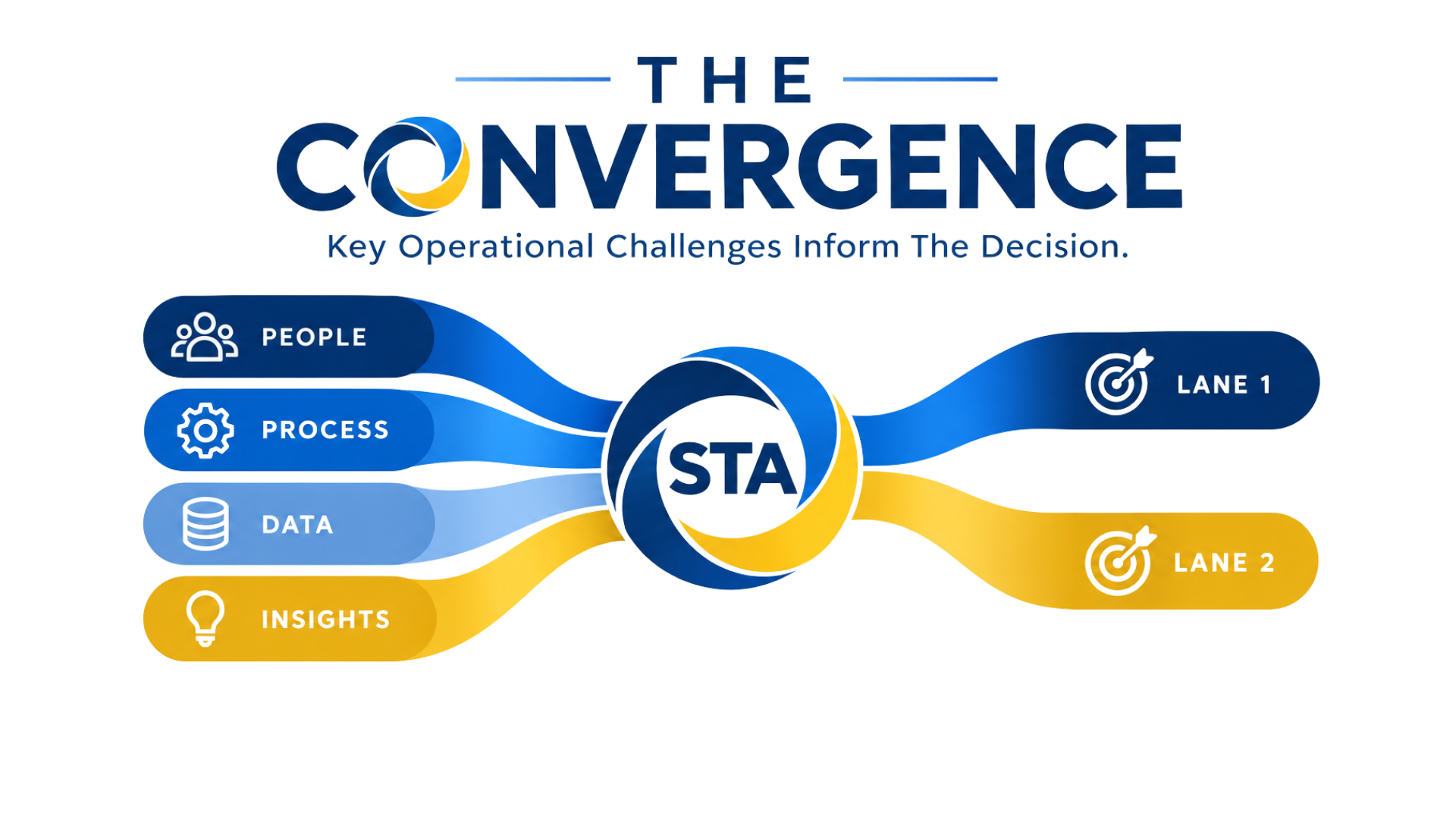
The Platform Decision isn’t one fork in the road. It’s the point where several independent variables — the shape of the organization, your capacity to deliver & support the work, where the company intends to be in five-to-ten years, and who the platform serves — run into each other at the same time.
None of those variables decide the lane on its own. A large organization isn’t automatically a transformation. A small one isn’t automatically an installation. It’s where they converge that tells you.
- Size alone tells you less than it seems to — a single-brand, single-process shop scales differently than a firm running several business lines under one roof.
- Complexity is what size often gets confused for: pay/bill variation by client, multi-state exposure, more than one line of business.
- Centralized vs. decentralized may be the strongest signal of all — enforcing one platform on a branch-autonomous model surfaces every private workaround at once.
- The field matters too: credentialing and compliance in healthcare, multi-state wage/hour in light industrial, VMS/MSP structure in IT and professional staffing.
- Internal business analysts and dedicated technology staff determine who owns the thousand small decisions a platform change requires.
- Their absence doesn’t shrink the work — it just leaves it unclaimed until someone outside the org picks it up.
- Process maturity: is how the business actually runs written down anywhere, or does it live in a few people’s heads?
- Data hygiene: can what’s in the current system be trusted enough to migrate, or does it need to be reconstructed first?
- A plan built on organic growth needs the platform to fit today’s process.
- A plan built on acquisition, roll-up, or being acquired needs the decision to anticipate someone else’s process joining yours later.
- Ownership structure — PE-backed, family-owned, ESOP — shapes sponsor reporting requirements, exit timeline, and appetite for a longer, more accountable engagement.
- A prior migration that went badly changes the risk tolerance and the political weather around this one, even when nothing else has changed.
- Standardized markup versus negotiated rebates, minimum guarantees, and blended rate structures create staffing software configuration demands that are independent of your internal maturity.
- MSP programs and VMS integrations introduce external technology requirements that staffing platforms must accommodate.
- A client portfolio dominated by a few strategic accounts requires different staffing technology capabilities than a diversified book of largely standardized business.
None of these four dimensions determine the answer on their own. In staffing technology, it is where the shape of the organization, its capacity to deliver and support the work, where the organization is headed, and who the platform ultimately serves intersect that reveals the most likely path forward. That intersection deserves its own analysis before a single software demonstration is scheduled or a vendor is invited into the conversation.
When that convergence indicates the need for transformation, the next question is not just which software should we buy? The next question is what type of transformation does this staffing business actually require based on a variety of financial, operational and cultural variables? The answer becomes a Staffing Technology Transformation Strategy shaped by the same staffing-specific variables, not a software shopping list borrowed from another firm’s implementation.
Not every platform change needs the same thing
But a meaningful share of the mid-market staffing pipeline isn’t that — and those are the engagements where the go-live date slips, adoption stalls after launch, and the new platform takes the blame for a problem it never caused.
The difference isn’t the software. It’s which lane the engagement is actually in.
- The business runs well; it needs a better system.
- Leadership already agrees on what done looks like.
- One platform out, one platform in.
- Success is measured by speed to launch and adoption.
- How the work gets done today isn’t documented — it lives in a few people’s heads.
- The old system was built around the company, and the company grew up around it.
- Multiple systems bolted together, none of them agreeing with each other.
- Leadership wants a different company on the other side, not the same one on new software.
- The people watching the money want results, not a status report.
Six principles your organization may need to evaluate to navigate — and separate — a launch from a reset
None of these are platform features. They’re how the engagement itself gets run — and they’re the difference between a system that goes live and a company that actually changes.
The fastest way to scale a broken process is to automate it. A business process library — built from the people doing the work, not a system spec — surfaces what has to change before a single screen gets configured.
No reseller margins, no utilization targets. Advisory that answers only to the client can say when the platform can’t do what was promised, or when the timeline — not the software — is the real problem.
One person owns the go / no-go call, with a date on the calendar to make it. Cutovers get staged, not forced, and every open risk carries a name, a severity, and a cost for every week it stays open.
The biggest risk in a platform change isn’t the platform — it’s running the new system the way the old one worked. Training, change management, and support discipline need an owner while the project is hot, then a clean handoff.
Most engagements stop at the platform’s edge. The harder work happens after: where the data goes next, whether the integrations do what everyone assumes, and reconciling the identifiers that have to match across systems.
Firms growing through acquisition need governance, process, and architecture that hold up to sponsor review — a playbook for bringing every acquired entity onto one operating model, not five different ones.
Tell us what you’re facing.
We’ll help you see where it converges.
Some organizations need an implementation partner for the Platform Decision. Others need help building the Transformation Strategy underneath it. Either answer is a fair one — you just want to reach it with your eyes open, not a vendor demo doing the talking for you.
Six-Dimension Key Operational Challenges Methodology
This diagnostic evaluates every business function through six consistent lenses — adapted from the traditional 6M Ishikawa root-cause model and refined for service-based and knowledge-based organizations rather than manufacturing environments. Operational reality is documented, challenged, validated, and standardized before any issue is classified, prioritized, or solved.
- IDocumentation before diagnosis. Independent interviews build a current-state narrative, which is expanded into a challenge register, compared against standards in a gap register, then cross-referenced against SOPs and additional interviews to reach a validated current-state assessment.
- IIProblem statement development. Validated findings become discrete, observable, measurable, attributable, and actionable problem statements — never complaints or opinions.
- IIISix-dimension classification. Each problem statement is mapped to its primary root-cause dimension in a fishbone view.
- IVProblem assessment. Each challenge is evaluated descriptively across all six dimensions — current reality first, before any discussion of solutions.
- VSolution architecture. Organizational, process, control, reporting, and governance requirements are defined first. Only then are technology platforms evaluated — kept platform-agnostic throughout.
- VIExecutive governance review. No recommendation becomes final without structured review for alignment, ownership, and risk acceptance.
- VIIExecutive synthesis & action planning. Findings collapse into three columns — Solutions, Actions (Dependencies), and Success Factors. Success Factors are binary, go/no-go gates (e.g. “payroll comparison testing achieves 99.5% accuracy”) — never aspirations like “team is happier.”
- VIIIOrganizational heat map. Every dimension is scored across every functional area on a four-color severity model — Red (critical), Yellow (improvement needed), Green (effective), Grey (not evaluated) — giving leadership a single view of organizational health.
The six dimensions themselves aren’t proprietary — they come from established root-cause analysis principles. What differentiates this approach is the governed sequence: Narrative → Challenges → Gaps → Standardization → Problem Statement → Six-Dimension Analysis → Solutions → Executive Governance → Heat Map.
People and Process are always addressed before Technology. Technology cannot solve an undefined process or compensate for unclear accountability.